
Issue 01 — Kimi Restoration Campaign · August 6, 2026
Rebuilding School on Kimi Island: Findings from Our August Field Assessment
On 4 August 2026 our team returned to Kimi Island with Congo Leaf Company Limited and a structural engineer to assess what it will take to rebuild the island school — and found a community facing hunger, a single shared toilet and a classroom block holding only nursery and P1.
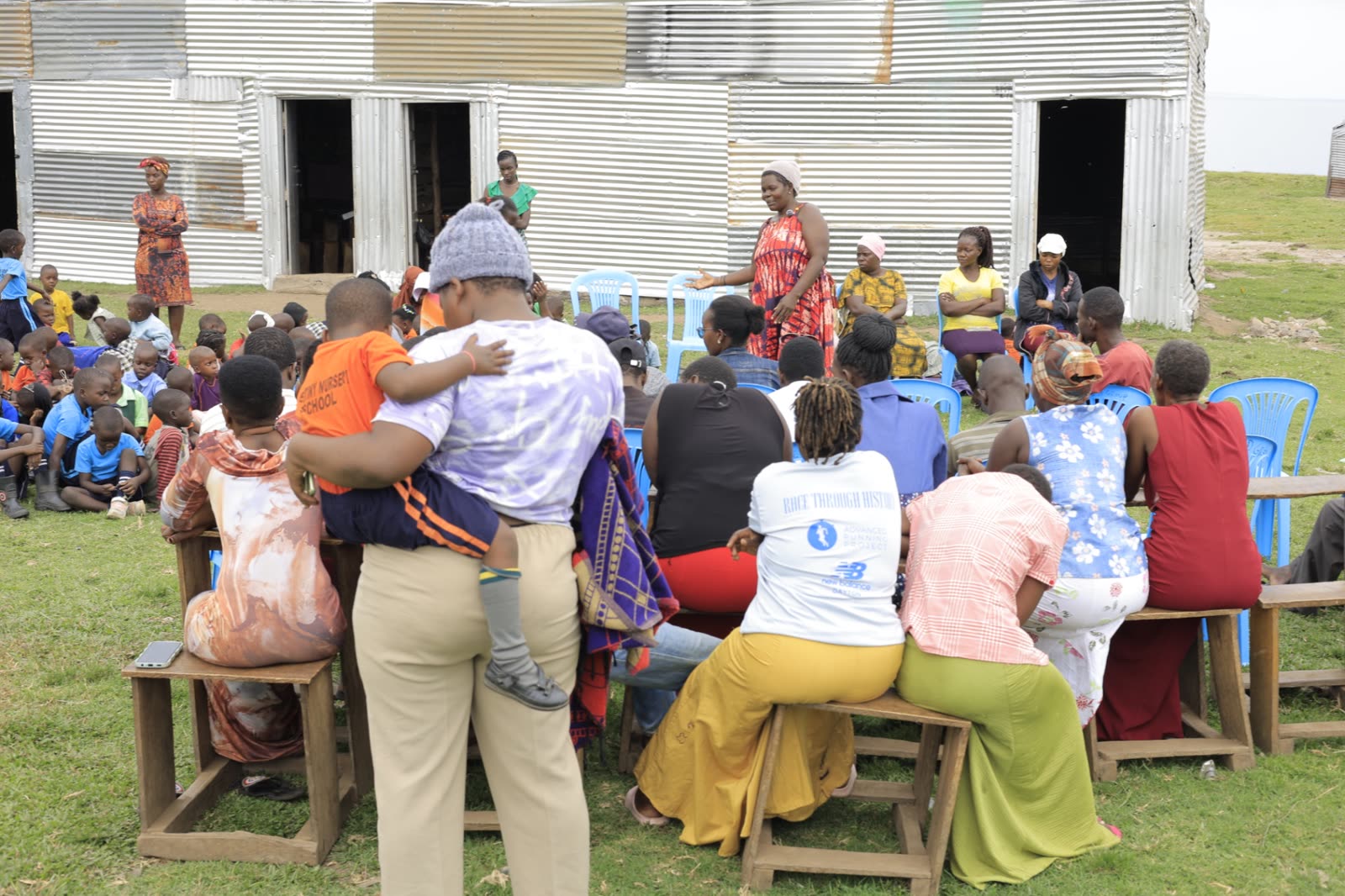
Kimi Island, Lake Victoria — 4 August 2026. Representatives of the Green Ambassadors Club travelled to Kimi Island for a joint site assessment with Mike of Congo Leaf Company Limited and an expert civil and structural engineer. Our aim was simple and urgent: establish exactly what is left of the island's education facilities, and agree a scope of work that can be funded and built.
Congo Leaf Company Limited has committed to partner with us to rebuild and expand the school in Kimi–Kachanga into a fully integrated, self-sufficient educational, nutritional and community hub — designed with systems that can sustain its own running rather than depend permanently on outside support.
How we got here
In 2017 a devastating fire swept across and destroyed the entire island. The Green Ambassadors Club launched the Kimi Restoration Campaign in 2021 to restore livelihoods, improve health and sanitation, promote environmental sustainability and build resilient community infrastructure. Last year, strong winds completely destroyed the island's community school, which had served pupils from Nursery through Primary 7. Facing severe financial constraints, the community could not rebuild it alone.
What we found on the ground
- A classroom block that stops at P1. Community-raised funds put up a small block this year, but capacity is limited to Nursery (Baby, Middle, Top) and Primary 1. Primary 2 pupils share a room with P1.
- Families who cannot pay UGX 60,000–72,000 a term. The fee is nominal, yet most parents live in extreme poverty and simply cannot meet it.
- Livelihoods erased overnight. Recent government bans on silverfish (mukene) fishing wiped out the island's main economic activity, leaving households with no income at all.
- Hunger in the classroom. One orphaned pupil, whose parents died when he was an infant, is raised by a grandmother who lost her income to the fishing ban; the family often goes days without food. Many pupils are in similar situations. The school has no kitchen, so children sit through long school days on empty stomachs — driving malnutrition, poor concentration and dropouts.
- One toilet for over 100 people. Pupils and staff rent and share a single toilet block with the surrounding community, creating serious health, hygiene and child-safeguarding risks.
- Idle older children. With no schooling beyond P1 and P2, older children are left without structure, compounding social problems across the island.
The school we are planning
The proposed facility is designed around 300 pupils — 30 per class across ten levels: Nursery Baby, Nursery Middle, Nursery Top, and Primary 1 through Primary 7, each with its own classroom.
The joint inspection confirmed what our team suspected: classrooms alone are not enough. Without sanitation, clean water and food, children will not stay in school. Food preparation and dining space are therefore formally part of the layout: an academic block with solar power, a sanitation block, a clean water system, a dedicated school kitchen and a multi-purpose dining and youth-skills hall.
Agreed priorities
- Sanitation block — a modern 10-stance facility, five stances for girls and five for boys, ending toilet rental fees and protecting children's health, dignity and privacy.
- Clean water infrastructure — an on-site UV filtration and supply system producing 20,000 litres of clean water daily for drinking, hygiene and the kitchen.
- Dedicated school kitchen — a modern, energy-efficient kitchen so daily meals can be cooked on site, directly tackling pupil hunger and boosting attendance.
- Full primary academic block — Nursery through P7 plus a staff and administration room, decongesting P1/P2 and restoring complete primary education.
- Multi-purpose hall — dining space for the school meal programme by day, and a vocational training and community centre for idle youth after school and at weekends.
- Renewable solar energy system — reliable power for early-morning and evening study, school electronics and site security.
Technical work completed on 4 August
- Structural and land assessment by the visiting engineer, planning spatial placement for classrooms, kitchen ventilation, solar orientation and water storage.
- Socio-economic assessment documenting financial distress, the impact of the silverfish ban and acute food insecurity among pupils.
- Formal scope agreement with Congo Leaf Company Limited to include a school kitchen alongside classrooms, sanitation, water, solar and the multi-purpose hall.
What happens next
- Within 5 days: engineering site survey report — Project Engineer.
- Within 10 days: architectural drawings and site plan, including kitchen and dining — Project Engineer.
- Following the drawings: detailed bill of quantities — Engineer with the Green Ambassadors team.
- Post-BOQ: budget consolidation and feeding-programme strategy — Green Ambassadors Club team.
- Post-budget: funding approval and MOA signing — Green Ambassadors leads and partners.
- To be confirmed: groundbreaking and Phase 1 construction.
How you can help
Every stance, every litre of clean water and every hot meal on Kimi Island is funded by people who choose to act. You can donate to the Kimi Restoration Campaign, contribute to our GoFundMe for island supplies and sanitation, or partner with us on the build.
Submitted by the Green Ambassadors Club — Kimi Restoration Campaign Team.